On July 4, 2026, America turns 250 years old. That is worth honoring. This country is beautiful. It is vast, diverse, creative, imperfect, and still full of possibility. It has given the world powerful language about liberty, equality, rights, and self-government.
Yet America has never fully lived up to its own promise.
The Declaration of Independence said all people are created equal. That idea was revolutionary. It was also incomplete. At the time, many people were enslaved. Women could not vote. Indigenous people were displaced. Disabled people were excluded. Equality was declared before it was practiced.
Still, America has moved forward. Slavery ended. Women gained voting rights. Civil rights laws challenged segregation. Disability rights became civil rights. Marriage equality expanded freedom. They prove that progress is possible.
But progress is not the same as completion.
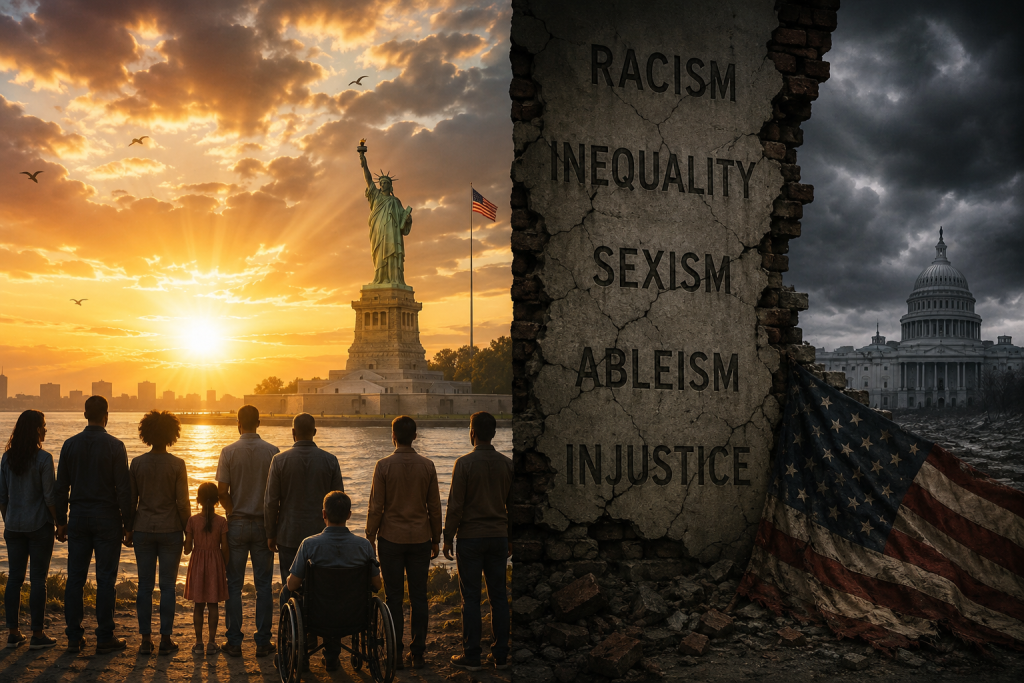
Racism still shapes outcomes in healthcare, education, employment, housing, and justice. Sexism still limits safety, pay, opportunity, and bodily autonomy. Ableism still creates barriers for people whose greatest limitation is often society’s refusal to accommodate them. These injustices overlap. Race, gender, disability, class, and age can combine in ways that deepen inequality (Bixby, 2024; Dorsey Holliman et al., 2023; Sheldon et al., 2026; UN Women, 2025).
It should never be beneath us, to be honest and patriotic.
History will remember that millions of Americans willingly returned to office a man convicted on 34 felony counts, found liable for sexual abuse and defamation in civil court, and whose long-standing association with Jeffrey Epstein remains an enduring part of the historical record. Whether one views those facts through a partisan lens or not, they raise difficult questions about the moral expectations we place on our highest elected office.
As a student of Locke, Aristotle, and Kant, I believe liberty requires moral responsibility. Freedom is not simply the right to do whatever one wants. Freedom requires reason, virtue, and respect for human dignity. A nation cannot call itself just if it excuses cruelty, rewards corruption, or treats some people as less worthy of protection.
Still, I do not believe America is lost.
I believe America is unfinished.
We have taken one thousand steps forward and seven hundred steps back. That still leaves us ahead of where we began. That still gives us ground to stand on. That still gives us a path forward.
The way back to justice is not mysterious. We need truth over propaganda. Evidence over rage. Courage over cowardice. Equal rights under law. Fair access to healthcare, education, housing, employment, and public life. We need leaders who understand that power is not a prize. It is a duty.
On America’s 250th birthday, we can celebrate without pretending. We can love this country without lying about it. Real patriotism is not blind loyalty. It is stewardship. It is the willingness to protect what is good and repair what is broken.
I still believe in America.
I believe we can become more honest, more humane, and more just. I believe we can move closer to the promise we inherited but have not yet fulfilled. One day, if we are brave enough to keep working, America may truly become the land of the free, the home of the brave, and a place of truth and justice for all.

References
Bixby, L. E. (2024). Intersectional inequalities: How socioeconomic well-being varies at the intersection of disability, gender, race-ethnicity, and age. Research in Social Stratification and Mobility, 91, 100938. https://doi.org/10.1016/j.rssm.2024.100938
Dorsey Holliman, B., Stransky, M., Dieujuste, N., & Morris, M. (2023). Disability doesn’t discriminate: Health inequities at the intersection of race and disability. Frontiers in Rehabilitation Sciences, 4, 1075775. https://doi.org/10.3389/fresc.2023.1075775
Gould, R., Mullin, C., & Harris, S. P. (2021). Race, disability, and employment. ADA National Network Knowledge Translation Center. https://adata.org/research_brief/research-brief-race-disability-and-employment
Martin, M. E., Haywood, C., Caldwell, K., Barry, C., Dawson, S., Hoppe, K., & Adekunle, T. B. (2026). Obstetric racism and ableism: A narrative review of barriers to obstetric care and maternal health outcomes for Black disabled women. Health Equity, 10(1). https://doi.org/10.1177/24731242261421862
Sheldon, T., Dhand, R., & Mykitiuk, R. (2026). Racialized ableism and the need for intersectional discourse and action. In M. al Attar & C. Smith (Eds.), Emancipating international law: Confronting the violence of racialized boundaries. Oxford University Press. https://doi.org/10.1093/9780198935605.003.0016
UN Women. (2025, June 12). Intersectional feminism: What it means and why it matters right now. https://www.unwomen.org/en/articles/explainer/intersectional-feminism-what-it-means-and-why-it-matters-right-now
Walter, L. (2026). From injustice to solidarity: Linking gender-based discrimination experiences to cross-issue political engagement. Journal of Women, Politics & Policy, 1–21. https://doi.org/10.1080/1554477X.2026.2657153